
Between 1964 and 1965 six women were found dead in and around the River Thames. All of them had worked as prostitutes, all had been strangled and all were naked, leading to their description as the 'Nude Murders.'
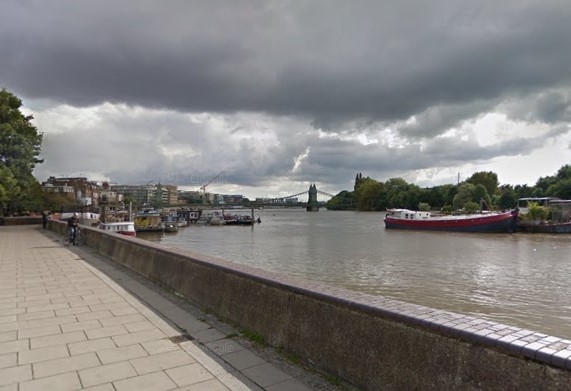
The first victim was 30 year-old Hannah Tailford, discovered in the river under a pier at Upper Mall close to Hammersmith Bridge on February 2, 1964. Her underwear was stuffed in her mouth.
Two months later on April 8 Irene Lockwood, 26, was found a few hundred yards upstream on the Thames foreshore.
Then on April 24, 22 year-old Helen Barthelemy was found dead in an alleyway off Swyncombe Avenue in Brentford, west London. This time there was a clue - small flecks of paint on the body.
The same pattern of paint colours was also detected on the body of Mary Fleming, who was found in a sitting position at the entrance to a garage in Berrymede Road, Acton, on July 14.
Detectives were still trying to track down motorcar spray-painting premises when Margaret McGowan, alias Frances Brown, was found dead on November 25. Her body was hidden under rubble and a dustbin lid in a Civil Defence car park in Hornton Street in Kensington.
'Frances Brown' had been in the newspapers the previous year when she gave evidence at the trial of osteopath Stephen Ward, one of the central figures in the Profumo affair. She had last been seen getting into a car - believed to be a Ford Zephyr or Zodiac - by fellow prostitute Kim Taylor and identikit pictures of the suspect were issued, without result.
Finally on February 16, 1965, Bridget 'Bridie' O'Hara was found behind a shed on the Heron Trading Estate in Acton.


Detective Chief Superintendent John Du Rose was recalled from holiday to lead the manhunt. He had policewomen dress up as prostitutes to walk the streets of Notting Hill and sent officers across west London to look for paint-spraying sites.
They didn't have far to look - the paint pattern was found opposite a paint spray shop on the Heron estate, not far from where Bridie O'Hara's body was found. This was where the bodies were stored before being dumped - but by who? Detectives believed he must have had some association with the estate and questioned 7,000 people from the area.
In an attempt to force the killer into exposing himself, Du Rose announced he was gradually whittling down the suspects. But the arrest never came, and the gamble appeared to have failed.
Du Rose later revealed in his book 'Murder was my Business' that the prime suspect had committed suicide before they could arrest him. He wrote: 'We had done all we possibly could but faced with his death no positive evidence was available to prove or disprove our belief that he was in fact the man we had been seeking. Because he was never arrested or stood trial, he must be considered innocent and will therefore never be named.'
This suspect was identified by writer David Seabrook as Mungo Ireland, who gassed himself with exhaust fumes in his garage on March 3, 1965. Ireland left a note reading: 'I can't stick it any longer... PS. To save you and the police looking for me I'll be in the garage.'
There are now conflicting opinions on whether this man was the killer or simply framed by the police after his death. It has also suggested that the same man may have been responsible for the murders of two other women found dead near the Thames in 1959 and 1963, Elizabeth Figg and Gwynneth Rees.
For this reason, the crimes of the serial killer dubbed 'Jack the Stripper' are said to remain unsolved.
Links:
The case is covered in the books Jack of Jumps by David Seabrook and Murder Was My Business
by John Du Rose.
Watch ITN news reports on the case of the Nude Murders
Feature on Jack the Stripper in the TruTV Crime Library website
Wikipedia page on Jack the Stripper