
Murders up or murders down? The strange world of homicide statistics

Did the number of murders in London increase or or decrease last year? It depends whether you mean calendar year or financial year.

Most headlines last week focused on the increase in UK murders to their highest level in a decade (or alternatively, lower than they were in 2007). Other reports went on the record level of knife crime offences (since comparable records began in 2011).

This fits in with the general picture in London, which saw an increase in the number of homicides (both murder and manslaughter) to around 130*, the most since 2008. The Metropolitan Police recorded the most knife offences (14,660, a one per cent rise since 2017).

But then another perspective was offered by the Metropolitan Police themselves, who released their latest financial year statistics (April 2018 to April 2019), which showed a significant drop in homicides from 163 in 2017/18 (or 154 not including terror attacks) to 122 in 2018/2019. The force was also able to highlight a reduction in knife injuries by 9.6% from 4,732 to 4,277, although there was a 0.5% increase in total knife crime offences (which would include possession offences).

The police say this is evidence that they have made progress in “tackling and reducing violent crime in the capital”. Perhaps it is also evidence that putting more effort and resources into policing, as a result of the outcry at the sharp spike in murders in early 2018, can affect the crime rate. We can only hope it points towards a significant reduction in murders in 2019.

Then again, it may simply be a reflection of the variation in the number of murders every day, week and month. The sharp rise in murders in February and March 2018 (19 and 20 respectively**) were enough to prompt headlines stating that the London murder rate had overtake New York’s (but you only looked at those two months, ignoring January 2018 or the year as a whole etc). The figures for the rest of the year, and the start of 2019, were significantly lower, although there were 15 homicides in March this year.

This variation in the number of murders over short periods is one reason why most murder statistics are analysed by year rather than by day, week or month. For example, in July 2008 there were four murders in London in one day. You could have viewed this as a sign of increasing violence in society, or you could have concluded that having four murders in one day was highly likely to happen once every three years.

Conclusion: Statistics are useful, as long as you know what you are looking at and can see how they vary over different time periods.

*we counted 129, the Metropolitan Police say 136, and media reports give figures varying between 132 and 135. It depends which cases you count as homicides.

**our figures, the Met say 18 for both months, but they can record cases differently depending on when they declare a case a homicide (rather than when the victim died).
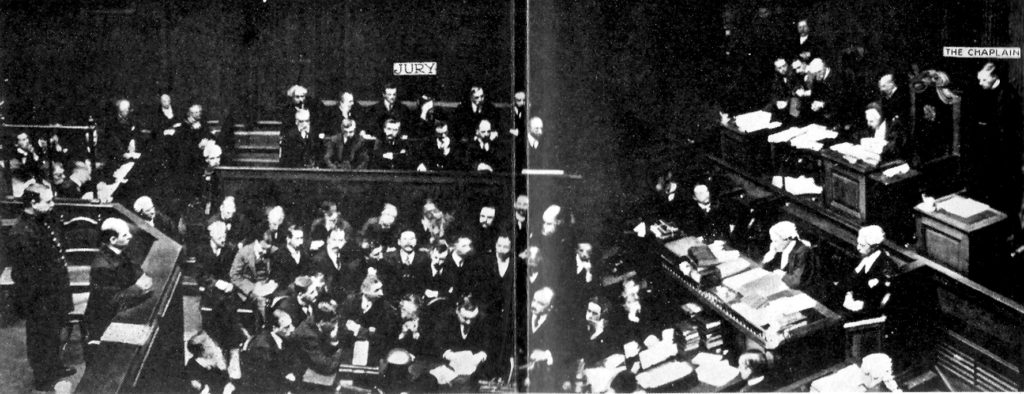
New Project: Full reporting of a murder trial

The sentencing of murderer Frederick Henry Seddon at the Old Bailey in 1812

The decline of court reporting over the last 25 years has been described as a “threat to justice”.

Local newspapers may not have the staff or resources to cover a trial in depth and the national press, TV and radio are naturally interested only in the most important or topical cases. Most court reports in the media will either be the start of a case (the prosecution opening, a summary of the evidence against a suspect) or the end (conviction and sentence).

But what about the witness evidence and the defence? Juries make their decisions based on all the evidence put before them (or at least they are supposed to do so), not the summaries provided by the prosecution, the defence or the media. If the public do not hear all the evidence (or at least the most important parts of it), it is perhaps not surprising that some jury verdicts are greeted with dismay (or even anger).

That is why we want to fully report a murder trial from start to finish to give the public a better idea of what happens in court. It will not be a verbatim transcript with ever umm and err – that would take too long to read, let alone write up – but it will be an in depth report of what happened with the most important parts quoted as accurately as possible.

Most murder trials last between two to three weeks. Sending a reporter to cover one trial all day would potentially cost (depending on the reporter or their employer) between £70 and £200 per day. We have therefore set a rough minimum of £950 to support full coverage of a short trial. If possible, the case chosen will be one that would otherwise receive very little coverage at all.

If the target is met, we will commit to providing daily coverage on the blog. All donors will also receive a long-read summary of the entire case upon its conclusion and an option to take part in consultation on the next project.

All of the above will be subject to legal restrictions such as the Contempt of Court Act and the Youth Justice and Criminal Evidence Act, for example. Explanation of the effect of these will, if possible, be provided.

Donations can be made via paypal to mailbox@murdermap.co.uk. Please email us at mailbox@murdermap.co.uk if you would like to fund this project or require further information.

You can subscribe to murdermap here

Changes to murdermap

[UPDATE 2022: The new website continues to track homicides as they happen and now has new, improved maps for each year since 2019 as well as a historical murder map (pre-2003). We are also working on a modern murder map for all cases since 2003. If you would like to contribute towards our costs, please consider becoming a subscriber.]

Unfortunately parts of the old murdermap website will disappear this week after nearly nine years’ service.

The main reason for this decision is that the site was based on a content management system (created by the original developers) that is no longer being supported.

Regular users will also have noticed that the map stopped working properly after Google brought in its new pricing plan in July 2018 and effectively ended the free Maps API service.

The choices were, therefore, leave the website up to deteriorate until it goes down completely (or, worse, gets hacked), or replace it.

Sadly it is also clear that the site is no longer sustainable in terms of time and resources. There are many reasons for this, but in reality the project was hamstrung from the start because it was based on the (unrealistic) idea that it could be funded by online advertising. It has only ever earned enough money to pay for hosting fees and most of the time the site has been maintained by one court reporter (although the information it contains is based on the work of many other people).

So what next?

Since murdermap began in 2010, the site’s database has grown to include more than 1,600 victims of homicide (including both murder and manslaughter, mostly for the years 2008-2018).

This database will not be lost. It has been saved offline and is likely to return in a different form at some point. And most of the original webpages have already been archived on the Wayback Machine.

After the original site comes down, it will be replaced by the murdermap blog while other avenues are explored. Crowdfunding may be difficult because running a site like this properly, with in-depth reporting of each murder in London, would require significant annual investment (see the Homicide Watch website in Washington DC for one example). Likewise turning murdermap into a subscriber-only site might be self-defeating, given that it was originally set up with the aim of publicly and openly tracking each and every murder – not just the high-profile cases that already attract media attention – to reveal the stories behind the crime statistics.

While murdermap had many frustrating flaws from the very start, hopefully this site has helped to inform the debate around violent crime in London. And even if murdermap disappears completely, in recent years there has been a greater focus on homicides and violent crime in London. During 2018 several national newspapers maintained lists of homicide victims in the capital and produced in-depth articles using maps and charts (one example being The Guardian). The Office for National Statistics is also providing a lot more detail about homicides than it did ten years ago. Long may this continue.

Cuts to the ‘Murder Squad’

The Metropolitan Police unit responsible for investigating murders* in London was cut by nearly 40 per cent between 2004 and 2017 (see table below).

Figures obtained via a Freedom of Information request show the Homicide and Serious Crime Command (HSCC) reduced in total strength almost every year over that period. The sharpest fall was from 2011 onwards.

The number of Major Investigation Teams (MIT), which are responisble for investigating homicide cases*, has also decreased from 26 to 18 since 2011.

While the total number of homicides fell by 50 per cent between 2004 and 2014, there were significant increases in 2015 and 2017 (according to Metropolitan Police figures).

There are likely to be around 150 homicides in 2018, although recent months have seen lower figures than at the start of the year, possibly because of the police response since.

Although there are many possible causes for the increase in violent crime since 2014, cuts to police budgets (and public services in general) across England and Wales may well have released the pressure or created some kind of “tipping point”.

The figures also show that the HSCC is now increasing in strength, with the figures for 2018 returning to a level last seen in 2013.

NOTES: The figures provided for “strength” (in response to the request for the “number of officers and staff”) were not whole numbers and have been rounded up or down accordingly.

*The Homicide and Serious Crime Command does not just investigate murder. It also takes on (for example) high profile crimes, “critical incidents”, serial stranger rapes, work-related deaths, unexplained deaths, and high risk missing persons enquiries.

The figures cover a period involving at least two structural reorganisations of the Met. For 2004 and 2005 the figures given are the total for the units designated SCD1(2), SCD1(3), and SCD(4). For 2006 to 2012 they are for SCD1. For 2013 to 2018 they are for SCO1.

The total “strength” given for the MITs (not included in table) usually accounts for around three-quarters of the total “strength” of the HSCC.

Although the FOIA request was for 2003 onwards, no figures were provided for 2003, when there were more than 200 homicides (various figures have been given ranging between 204 and 216).

Table: Strength of the Homicide and Serious Crime Command (or equivalent) 2004 to 2018

Off The Map: Oluwadamilola Odeyingbo

The case of 18 year-old Oluwadamilola Odeyingbo has been removed from the database after the Metropolitan Police concluded it was not a homicide.

Their decision was taken after a special post-mortem gave a cause of death as multiple organ failure from a pre-existing medical condition.

The police statement reads:

The cause of death has been established for an 18-year-old man who died in Chislehurst in January.

Oluwadamilola Odeyingbo, 18, died in hospital on the morning of 10 January 2018 from injuries sustained following a reported altercation in Empress Drive just after 21:00hrs the previous evening.

A post-mortem examination conducted on 12 January failed to establish a cause of death. A special post-mortem has now concluded gave a cause of death as multiple organ failure from a pre-existing medical condition.

Officers from the Met’s Homicide and Major Crime Command, having consulted with the CPS, are satisfied that no offences of murder or manslaughter have been committed.

There are ongoing enquiries in relation to other offences not linked to the death of Mr Odeyingbo.

Here is our original case summary for the record:

Oluwadamilola Odeyingbo, 18, died after being assaulted in Chislehurst.

He was found collapsed in a garden in Empress Drive at around 9pm on 9 January 2018.

Mr Odeyingbo died in hospital the next morning.

An 18-year-old man was arrested on suspicion of murder on 10 January before being released on bail.

Detective Chief Inspector Tim Wright, said: “We understand that neighbours and people passing through the area witnessed the incident on Tuesday evening. We are keen to speak to all witnesses and would encourage them to come forward as soon as possible.

“A young man has lost his life and we are doing everything we can to piece together what took place.”

Anyone with information concerning this incident is asked to call the incident room on 020 8721 4961 – you can also tweet @MetCC. Alternatively, contact Crimestoppers anonymously via 0800 555 111.

Metropolitan Police