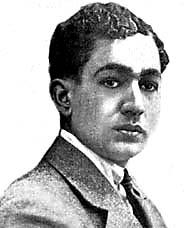
The trial of French socialite Marguerite Fahmy for the murder of her wealthy husband at the Savoy Hotel was the sensation of its day.
At around 2am on 10 July 1923 a porter heard three shots coming from their luxury suite and ran to the door to see 22 year-old Ali Fahmy slumped against the wall. He had been shot in the head.
After throwing the gun to the floor, Mrs Fahmy, 32, was heard to say repeatedly ‘Qu’est-ce que j’ai fait, mon cher?’ (What have I done, my dear?). She also told the porter ‘J’ai perdu la tete’ – which was translated both as ‘I lost my head’ or ‘I was frightened out of my wits.’
Mrs Fahmy went on trial at the Old Bailey in September 1923. Her defence was that her husband had tried to strangle her and then advanced towards her with a Browning .32 pistol. She took the gun from him and pointed it at his head before opening fire.
Her barrister Edward Marshall Hall portrayed Mr Fahmy as a violent, abusive husband with unnatural sexual demands.
The prosecution were refused the right to cross-examine Mrs Fahmy about her previous history of relations with other men – it was said she was a high-class escort and former teenage prostitute in Paris and Bordeaux.
On 14 September the jury acquitted her of all charges after less than an hour’s deliberation. Mrs Fahmy walked free from court and returned to Paris, where she died in 1971.
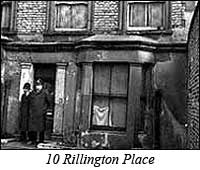
Number 10 Rillington Place no longer exists on the map but it was once the most notorious address in London.
It was at this terraced house in Notting Hill that John Reginald Halliday Christie killed at least six women including his wife Ethel between 1943 and 1953.
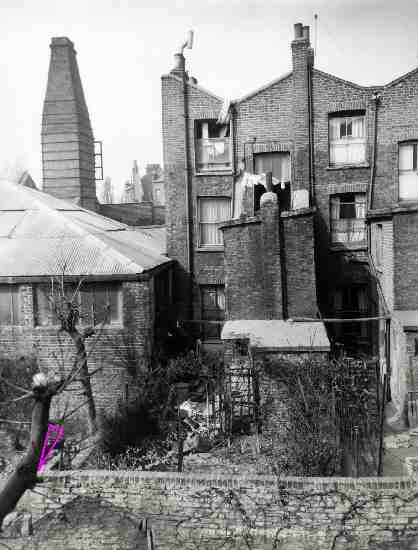
A view of the rear of 10 Rillington PLace
He is also thought to have been responsible for the murders of his fellow tenant Beryl Evans and her baby daughter Geraldine – murders which were originally blamed on Beryl’s husband Timothy.
Christie gave evidence against Timothy Evans at the Old Bailey in 1950 and Evans was found guilty and hanged.
But after his capture and arrest Christie confessed to killing Beryl Evans and controversy still rages over whether Timothy Evans was the victim of a gross miscarriage of justice.
In 2004 the Criminal Cases Review Commission decided against a referral to the Court of Appeal on the grounds of cost but admitted that it was unlikely Evans would be found guilty on the basis of Christie’s status as a serial killer.
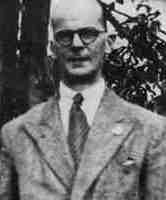
John Christie
Christie was born in 1899 and served in the First World War before being injured in a mustard gas attack.
He was known for speaking in a whisper and is said to have relied on the services of prostitutes after being branded ‘Reggie-No-Dick’ during his teens.
Christie married his wife Ethel in 1920 and had a series of jobs, including postman, before being taken on by the War Reserve Police in 1939 – despite having convictions for theft and assault.
By this time the couple had moved in to a ground-floor flat at 10 Rillington Place.
Four years later in August 1943 he committed his first murder, strangling Ruth Fuerst, an Austrian munitions factory worker, in his bed while his wife was away.
The body was at first hidden under the floorboards but was later buried in the back garden.
It was soon joined by a second victim, Muriel Amelia Eady, a 32 year-old colleague, on 7 October 1944.
After persuading her that her bronchitis could be cured by inhaling his ‘special mixture’, Christie subdued her with carbon monoxide before raping and strangling her.
Neither corpse was discovered when detectives searched the house looking for missing mother Beryl Evans and her daughter Geraldine in late November 1949.
They were found in a washhouse in the back garden. Beryl had been strangled and wrapped up in a green tablecloth while Geraldine had been strangled with a man’s tie and hidden under a piece of wood.
It is thought Beryl Evans was killed on November 8, 1949. According to the story Christie gave at trial, he and his wife heard a ‘bump’ during the night and the following morning Timothy Evans claimed Beryl had gone away to Bristol.
Timothy Evans, who had a low IQ, confessed on four separate occasions that he was responsible, claiming he had killed his wife in a fit of temper. But after being charged with murder he told officers: ‘Christie did it.’
Evans was tried at the Old Bailey on January 11, 1950, and was found guilty by the jury after only 40 minutes deliberation. He was hanged on March 9.
Christie carried on with his own life, getting a job as a clerk and taking on new tenants at 10 Rillington Place.
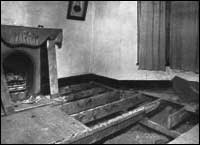
Two years later on 14 December 1952 he strangled his 54 year-old wife and hid her body, wrapped in a blanket, under the floorboards in the parlour.
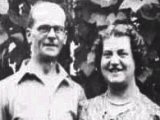
John and Ethel Christie, and the location of Ethel’s body
Christie pretended she had gone away and sold all his furniture including the bed as well as his wife’s wedding ring and watch.
Perhaps aware that he would soon be found out, Christie killed three more women over the next three months.
Rita Nelson, 25, was last seen alive on January 13, 1953, and is thought to have been killed by January 19. Kathleen Maloney, a 26 year-old local prostitute, was last seen in early to mid January but was probably killed after Rita Nelson. Hectorina Maclennan, 26, was killed at some point before Christie moved out of the flat on March 20, 1953.
All were gassed, raped and strangled and hidden in the kitchen in an alcove covered over by wallpaper.
Four days after Christie moved out, a tenant broke through the hollow wall while trying to install a shelf for his wireless radio. The police search that followed also uncovered the body of Ethel Christie in the parlour and a tobacco tin containing clumps of pubic hair.
In the garden, officers saw a human thigh bone propping up the fence. Further bones were found strewn around the garden with a newspaper fragment dated 19 July 1943. These remains were to be identified as Ruth Fuerst and Muriel Eady.
By then Christie was on the run and his name and photograph were plastered on the front page of every newspaper.
He spent the next week sleeping rough on benches before being spotted by a police officer on Putney Embankment on March 31. He was carrying a newspaper clipping referring to the arrest of Timothy Evans.
Christie quickly confessed to the last four murders, claiming he strangled his wife to put her out of her misery after she woke him up, choking and blue in the face. He said he was forced to kill Nelson, Maloney and Maclennan when they became aggressive.
While in Brixton Prison, he boasted his goal had been to kill 12 women and compared himself to John George Haigh, the acid bath murderer.
He later confessed to the Fuerst and Eady murders, writing: “I remember as I gazed down at the still form of my first victim, experiencing a strange, peaceful thrill.”
Christie also admitted to strangling Beryl after offering to abort her unborn child but did not mention the daughter Geraldine.
His turn to stand trial in Court One at the Old Bailey came on June 22, 1953. Pleading not guilty by reason of insanity, he described all seven murders from the witness box.
After four days of evidence, the jury found him guilty. He was sentenced to death and was hanged at Pentonville Prison on July 15. He was 54 years old.
A year later Rillington Place had its name changed to Ruston Close but number ten continued to be rented out to tenants.
But in the early 1970s – after the film 10 Rillington Place was filmed – the whole street was demolished.
The exact site – not far from Bartle Road – has now been built over.
Support murdermap
We rely on subscriptions and donations to fund the website. Sign up for just £5 per year.
In February 1983 a tenant at 23 Cranley Gardens in Muswell Hill complained that the toilets were blocked and the Dyno-rod company was called in to investigate. What they discovered in the drains would lead to the arrest of one of Britain’s most prolific serial killers.
Dennis Nilsen, a 37 year-old civil servant living in the attic, had murdered at least 15 men in the space of five years. In many cases he would keep the corpses in his home for several months before cutting them up and disposing of them, either on a bonfire or by flushing them down the toilet.
He would later confess to having sex with the dead bodies of his victims.
The first known victim was 14 year-old Stephen Holmes on December 30, 1978. Nilsen invited him back to his flat at 195 Melrose Avenue in Cricklewood, strangled him with a necktie and then drowned him in a bucket of water. Eight months later Nilsen burnt the body in the garden.
On 3 December 1979 Kenneth Ockendon, a 23 year-old Canadian student, was invited back to the same address and strangled. He was followed by 16 year-old Martyn Duffey on May 17, 1980 and 27 year-old Billy Sutherland in August 1980.
According to his later confession, he would go on to kill seven other unidentified male victims before the murder of Malcolm Barlow, 23, on September 18, 1981. He burned five of those on a bonfire at the back of his home on October 4, 1981. The next day he moved to 23 Cranley Gardens.
The first victim at the new flat was John Howlett, 23, in March 1982. He was followed by Graham Allen, 27, in September 1982 and finally Stephen Sinclair, 20, on January 26, 1983.
Nilsen was arrested two weeks later on 9 February after the discovery of human flesh in the drains. When questioned by detectives at the flat he feigned shock before showing them two bags full of body parts in his cupboard.
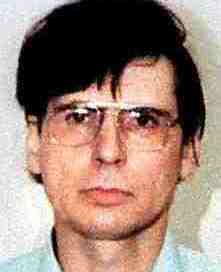
Dennis Nilsen
On 24 October 1983 he went on trial at the Old Bailey. Nilsen denied the charges on the grounds of diminished responsibility but was convicted of six murders and sentenced to life imprisonment with a recommendation that he serve 25 years.
Ten years after his conviction ITV broadcast an interview with Nilsen in prison in which he discussed his crimes. The following year, in December 1994, the home secretary Michael Howard decided he should never be released from prison.
Nilsen died in hospital of natural causes on 12 May 2018.
Yvonne Fletcher, a 25 year-old officer with the Metropolitan Police, was shot outside the Libyan Embassy on 17 April 1984.
She had been monitoring a protest by opponents of Muammar Gaddafi in St James’ Square when a burst of automatic gunfire rang out at around 10.17am.
Ten protestors were injured and WPC Fletcher was wounded in the stomach. She died an hour and a half later in hospital at 11.50am.
It is thought the fatal 9mm bullet was fired from the first floor of the embassy.
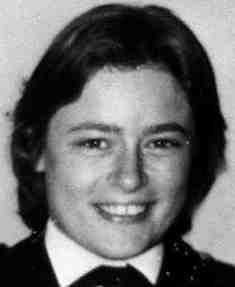
Yvonne Fletcher
For the next eleven days the building was besieged by armed police. The standoff only ended when the Government, fearful about reprisals against British Embassy staff in Tripoli, agreed to deport all the staff rather than arrest and prosecute any suspects.
The following week, on May 3, 1984, the Police Memorial Trust was established to honour British police officers killed in the line of duty. The Trust unveiled a memorial to Yvonne Fletcher, who had joined the Met aged 19, in St James’ Square on February 1, 1985.
It was not until 1999 that the Libyan Government accepted responsibility for the shooting and agreed to pay compensation to the policewoman’s family. However nobody has yet been convicted for the murder.
In August 2011 Yvonne’s mother Queenie Fletcher said the end of the Gadaffi regime represented “the best chance to find my daughter’s killer.”
She said in a statement: “Even after all these years, I very much hope that somebody is brought to justice. I shall be very pleased if there is a new judicial process which can find my daughter’s killer.”
On July 17, 2012, two detectives from the MPS Counter Terrorism Command travelled to Libya as part of the investigation.
On 17 April 2014 the family of Yvonne Fletcher said in a statement: “Thirty years ago today, Yvonne was shot and killed outside the Libyan People’s Bureau in St James’s Square. To many it may seem like a fading memory but to the family it is as clear as yesterday.
“We have had to move on with our lives but it is difficult to move forward when the past remains unresolved. Closure is important to the family so that we can remember Yvonne as the happy caring person she was.
“We can look back and wish things had been handled differently but here we are 30 years later, having dealt with numerous governments and a dozen or more Foreign Secretaries and it seems no closer to achieving justice for Yvonne.
“Our desire for justice is as strong as ever and we continue to support the Metropolitan Police in their ongoing investigation. The truth about what happened 30 years ago is just as important to us today as it was then.
“It is time this case was closed, 30 years of being in the news and dealing with the pressure of media attention takes its toll on all the family, more than you will ever know.”
On 19 November 2015 a man in his 50s was arrested on suspicion of conspiracy to murder in relation to the shooting.
The Metropolitan Police also issued 14 pictures of men they want to identify as part of the investigation.
Images taken from video footage of a demonstration outside the embassy
A reward of £50,000 was offered for information leading to the arrest and prosecution of those responsible for the murder.
On 16 May 2017 the Crown Prosecution Service confirmed it was unable to pursue a prosecution in respect of the murder.
The Metropolitan Police said the man arrested on suspicion of conspiracy to murder had been released with no further action and added: “We believe our investigation has identified enough material to identify those responsible for WPC Fletcher’s murder if it could be presented to a court. However the key material has not been made available for use in court in evidential form for reasons of national security.
“Therefore, without this material and following a review of all the evidence that was available to prosecutors, the Crown Prosecution Service – who we worked closely with throughout – have informed us that there is insufficient admissible evidence to charge the man.
“This was an act of state-sponsored terrorism and was part of a brutal bombing and shooting campaign waged by the Gaddafi regime during the 80s and 90s, targeting Libyan dissidents in the UK and across Europe, known as the ‘stray dogs campaign’.
“The murder of WPC Fletcher resulted in a police siege at the Libyan People’s Bureau lasting 10 days, after which 30 of the occupants of the bureau were deported back to Libya and the British Government severed diplomatic relations with the Libyan regime.
“Although our investigation has always remained open, cases like this do become harder to solve over time. Our judgement is that this concludes what was by far the best opportunity to solve this tragic case and provide a degree of closure for the victims and their families.
“This investigation will never be closed but the likelihood of finding further evidence, in Libya or elsewhere, is low.”
Assistant Commissioner Mark Rowley, of the Met Police, said: “WPC Fletcher was just 25 years old when she was killed. She had joined the Met Police age 18 and I know that throughout her seven years of dedicated service she earned great respect from her colleagues and the community she served.
“The murder of a British police officer in broad daylight, outside an embassy, provoked a powerful reaction from the public and from officers at the time, and the tragedy of WPC Fletcher’s death continues to resonate with officers today.
“Every year, on the anniversary of WPC Fletcher’s death, serving and retired officers from the Met visit her memorial at St James’ Square to remember and mark their respects to a valued officer.
“I am extremely proud of the exceptional work the investigative team and the Crown Prosecution Service have carried out. I know they were incredibly determined to identify those responsible for the senseless murder of a colleague.
“I regret that we have not been able to deliver the justice that the victims and their families deserve.”
The family of WPC Yvonne Fletcher said in a statement: “We understand that some available evidence could not be used in court but are satisfied that the Metropolitan Police has left no stone unturned in its pursuit of justice in Yvonne’s case.
“The family would like to thank the Met for its continued hard work and diligence and also for always keeping us informed at every turn.
“We are deeply disappointed and frustrated that a prosecution cannot proceed at this time. We had hoped that the latest turn of events would finally lead to some closure for the family.”
On the 40th anniversary of the murder, in April 2024, the Met Police confirmed there were no active lines of enquiry but said officers would assess and investigate any relevant new information.
______
Notes and sources:
Footage of the demonstration outside the Libyan Embassy and the shooting of WPC Yvonne Fletcher on 17 April 1984 can be seen on YouTube. (Age restricted due to community guidelines).
The disappearance of Lord Lucan is one of the most intriguing mysteries in modern British history.
Richard John Bingham, 7th Earl of Lucan, was 40 when he fled justice after the murder of his children’s nanny Sandra Rivett on November 8 1974.
He has never been seen since, although countless theories have sprung up as to what actually happened to him.
Some believe he killed himself in the sea off the coast of Newhaven. Others claim he started a new life abroad, either in South Africa, Goa or New Zealand. Officially, he was declared dead in October 1999.
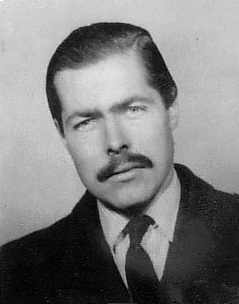
Lord Lucan
Known as ‘Lucky’ Lucan because of his fondness for gambling, he was educated at Eton College and served in the Coldstream Guards before taking up the earldom on the death of his father, a hereditary peer in the House of Lords.
By 1974 he had separated from his wife, Countess Veronica Lucan, who was living with their three children at 46 Lower Belgrave Street.
At 9.45pm on Thursday, November 7, the countess burst into a nearby pub, the Plumber’s Arms, and shouted: ‘Murder, murder! He’s tried to kill me!’
She was bleeding from wounds to her head and was taken to hospital after collapsing unconscious.
Police broke into the house and found the children unharmed – two were asleep and a third was watching TV in her bedroom.
But when officers went down to the basement they found blood splashed on the wall, bloody footprints and a canvas bag containing the body of Sandra Rivett.
She had severe injuries to the back of her head, most probably caused by a piece of lead piping wrapped with tape found nearby.
Lucan’s wife was later to tell police that she had been watching Mastermind on TV when the nanny asked her if she wanted a cup of tea.
When 29 year-old Miss Rivett did not return with the drink she went into the hallway to investigate.
At the top of the stairs leading down the basement she noticed the light switch did not work and called Sandra’s name. Suddenly she was beaten over the head with a heavy object.
The countess explained that she recognised her attacker as her husband and managed to fight him off by grabbing his testicles. According to her statement to police he then calmed down and admitted the nanny was dead.
She has later admitted that she offered to help him conceal the body but then seized her chance to escape when he went to the bathroom to fetch a cloth to tend to her wounds.
Many, including the countess himself, believe that Lucan mistook the nanny for his wife in the darkness, having taken out the lightbulb in preparation for his attack.
Lucan certainly had a motive – his wife had won custody of the children a year earlier and he had been left heavily in debt. He is said to have expressed a desire to kill her in conversations with two friends.
When police went to Lucan’s apartment in Elizabeth Street he was already gone, although his car keys, passport and driving licence were still in the flat.
He is known to have turned up at a friend’s home and made several phone calls, including one to his mother. He also wrote two letters to his sister-in-law’s husband, in which he claimed to have interrupted a fight between his wife and an intruder.
Lucan suggested his wife was paranoid and added: ‘The circumstantial evidence against me is strong in that V. will say it was all my doing and I will lie doggo for a while, but I am only concerned about the children.’
He was last seen at 1.15am driving away in a Ford Corsair, which was found three days later abandoned on the coast near Newhaven. One of his last acts was to write another letter to his friend Michael Stoop, who had lent him the car, which began: ‘I have had a traumatic night of unbelievable coincidences.’
His version of events were rejected in June 1975 by the inquest jury, who publicly named Lucan as the murderer. A month later a bill was passed banning coroner’s courts from identifying the killer, making it the last such verdict in the UK.
While there have since been thousands of sightings of him all over the world, none have been confirmed and police have not uncovered any proof he is still alive.
Lucan’s wife makes her position clear on her website: ‘I have publicly stated since 1987 that my late husband is not alive and I sometimes use the prefix ‘dowager’ to make my position clear which is that of a widow.’
Then in 2012 a witness came forward to say she arranged for Lucan’s children to fly to Africa between 1979 and 1981 so that he could see them from a distance.
Whatever the truth, the name of Lord Lucan, like that of the missing racehorse Shergar, has passed into folklore.
Further detail on the case can be found online at the Crime Library website and Wikipedia.
The Countess of Lucan has also set up a website in an attempt to counter conspiracy theories, called Setting the Record Straight. The passport photo of Lord Lucan used to illustrate this article can be found there among other family photographs.